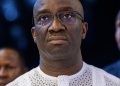
With the propaganda and intrigues that accompany electioneering now over, tomorrow happens to be the turn of Bayelsans to speak with their Permanent Voter Cards (PVCs) on who, between Governor Seriake Dickson of the Peoples Democratic Party (PDP); and former Governor Timipre Sylva of the All Progressives Congress (APC) – the man Dickson displaced four years ago to emerge as governor should be the chief executive of their state. The intervening campaign turf was really tough and energy sapping for both Dickson and Sylva, no doubt. Dickson, Sylva and other parties’ governorship candidates had signed a peace accord supervised by the hierarchs of the Independent National Electoral Commission (INEC) on November 10 in Yenagoa, the Bayelsa State capital, in which they all agreed to ensure a peaceful and violence-free poll. Baring all political brick-bats and foibles, we assume they played according to not just the rules of the accord, but the dictates of extant electoral laws.
The electoral umpire, INEC, said a couple of days ago that it had improved on its logistics and was ready to conduct a hitch-free governorship election in Bayelsa tomorrow. Mr. Baritor Kpagih, the Resident Electoral Commissioner (REC) in Bayelsa State, said the Commission prepared well for the election; and that INEC’s office in the state had started taking delivery of sensitive and non-sensitive election materials. He said the distribution of the materials would begin as soon as they were all fully delivered.
The police, too, said they were ready. The Inspector-General of Police, Mr. Solomon Arase, was quoted as saying in Yenagoa, Tuesday, December 1, that 14, 000 police officers and men would be deployed to provide security before, during and after the poll. “We are very ready for the Bayelsa election. We did a similar thing two weeks ago in Kogi State and we have decided to replicate it here in Bayelsa… We are going to dominate the security space; we are going to have aerial surveillance. We are going to lock down the waterways. A DIG (Deputy Inspector-General of Police) is supposed to come and supervise the election here with three additional commissioners and about 15 units of police mobile force. So, we are very ready”, Arase stated.
The Bayelsa governorship election is one of two such staggered polls slated for this year. The first was that of Kogi held on November 21. Being the first acid test for the new INEC Chairman, Prof. Mahmood Yakubu, preparations for the poll were no less tight than what is currently on ground in Bayelsa. But in the end, INEC, in its wisdom, declared the Kogi poll inconclusive, a decision that was compounded by the sudden death of the APC candidate in that poll, Prince Abubakar Audu, who was less than a whisker away from victory. The Returning Officer for the election, Professor Emmanuel Kucha, the Vice-Chancellor of Federal University of Agriculture, Makurdi, Benue State, said the cancellations were due to insecurity, ballot boxes’ snatching and related electoral frauds witnessed in Adavi, Ofu, Ajaokuta, Bassa, Ankpa, Dekina, Ibaji, Idah, Okehi, Okene, Omala, Olamaboro, Yagba- West, Lokoja, Kogi, Kabba/Bunu, Igalamela-Odolu and Ijumu Local Government Areas.
Results from 21 LGAs, however, indicated that Audu was ahead of the incumbent governor, Idris Wada of the PDP, with 41,353 votes, having polled 240,867 votes against Wada’s 199,514 votes. Kucha said 49,953 votes were cancelled in 91 polling units across 18 LGAs, a figure he said was higher than the margin with which the late Audu was leading Wada, hence INEC’s decision to declare the poll inconclusive. If, however, it is confirmed, the report that of the roughly 49,000 votes at stake, only 25,000 are backed by PVCs, it then follows that even if all the 25,000 cast their votes for the PDP, APC would still have won. This being so, INEC ought to be held solely responsible for the political logjam in Kogi, presently, for its arbitrary application of discretion by declaring the Kogi election inconclusive, without appraising all the facts at its disposal that would most probably have assisted it isolate and declare the APC candidate the clear winner.
Besides, apart from the problems of insecurity and ballot boxes’ snatching which Kucha made reference to as basis for the cancellation of results in 91 polling units, the election was reportedly marred in some areas by violence, failure of card readers, omission of names in voters’ register, etc. We have no reason to doubt how prepared INEC and the security apparatus are for the Bayelsa polls. But a repeat of the Kogi imbroglio in Bayelsa is unacceptable. The electoral body, especially, should better be really prepared.