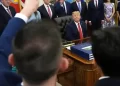
President Muhammadu Buhari returned from a recent state visit to the United States with a firm assurance of assistance to Nigeria in battling Boko Haram insurgents to submission. Both President Barack Obama and John Kerry, Secretary of State, at their separate meetings with Buhari, underlined America’s resolve. Undoubtedly, this is a welcome relief for our beleaguered country, as the terrorists have upped the ante since May 29 when Buhari assumed office.
Agence France Presse reports that 653 persons were killed in one month after Buhari took over; from bomb attacks in markets, worship centres, motor parks and streets. The upsurge is clearly a reversal of the gains the military made before June; a matter that suggests operational and intelligence inadequacies.
Kerry said both nations had agreed to “join together in an effort to do a better job of taking on Boko Haram.” To rout the insurgents, Nigeria needs high-tech military equipment like drones, attack helicopters and fighter jets, shared intelligence and training of our military personnel for optimal performance in battle. Under former President Goodluck Jonathan, Nigeria got the cold shoulder from the US in these areas, following alleged human rights abuses by the military, a cocktail of official corruption and a diplomatic stand-off between the two countries.
It is heartwarming to hear from a US Congress Judiciary Committee delegation that visited Nigeria recently that the arms embargo on the country would be lifted. Mr. Daniel Issa, head of the delegation, said so in Abuja. Fears were palpable before now that Obama could be hamstrung by the Leahy Act, which forbids the US State Department or the Department of Defence from giving military assistance to a state or force accused of human rights violations. Amnesty International had alleged that our soldiers killed innocent civilians in the North-East during operations, a charge the military denied.
With the level of carnage and destruction of property still being perpetrated by insurgents, Buhari should demonstrate a sense of urgency in mapping out effective and result-oriented strategies. Nigerians want to see an immediate difference in the execution of the terror campaign between his government and that of his predecessor. This is understandable given his military antecedents.
The relocation of the military command centre to Maiduguri (the centre of the crisis); visits to Chad, Benin Republic, Cameroon and Niger Republic to consolidate their support; holding a strategic meeting with countries involved in the Multi-national Joint-Task Force (comprising Nigeria, Chad, Niger and Cameroon); and the release of $21 million to the Force for operational effectiveness, are commendable steps Buhari has taken so far. And enamoured of these efforts, the US released a grant of $5 million to Nigeria.
These measures have, however, yet to yield the full desired results. In the use of suicide bombers, rather than engaging Nigeria’s military frontally, the Islamist fighters have changed their operational tactic. An effective intelligence-gathering system involving all security services is urgently needed, therefore, if the military are to be ahead of the terrorists. The 19 people killed in Damaturu, Yobe State, a fortnight ago, by a 10-year old female suicide bomber, and similar attacks that preceded it, would have been nipped in the bud had there been actionable intelligence.
At a ceremony, where Kenneth Minimah formally handed over the baton to Tukur Buratai as the new Chief of Army Staff, he reminded him that the Army had “sufficiently degraded” the insurgents. The new military leaders should discountenance such views. In line with the asymmetric warfare strategy of international terrorism, Boko Haram has perfected the art of changing tactics at the drop of a hat.
The Central Intelligence Agency defines asymmetrical warfare as the use of innovative strategies, tactics and technologies by a weaker state or a sub-state adversary, intended to avoid the strengths and exploit the potential vulnerabilities of a larger and technologically superior opponent. This includes two aspects. First, the selective use of weapons or military resources by a state or sub-state group to counter, deter, or possibly defeat a numerically or technologically superior force; and second, the use of diplomatic and other non-military resources or tactics by a state or sub-state group to discourage or constrain military operations by a superior force.
Boko Haram is adept at imitation. Therefore, it is the responsibility of the new military leaders to coordinate defence activities with other agencies such as the police and other para-military forces, intelligence agencies and emergency response organisations. This will require strong cooperation with friendly countries, especially our immediate neighbours. As the US-based Institute for Defence Studies and Analyses advised, we must develop strategies and plans for applying armed forces to frustrate the violent actions of the terror group at the least possible cost in time, resources and casualty rates. The Federal Government should also handle the new dialogue bait with utmost care. Like most terror groups, Boko Haram employs what Wall Street Journal calls “a patient method of fighting that engages only when the odds are in their favour. When it goes badly, they always look to any well-meaning body to interfere long enough to regenerate their forces and return to the fight.”