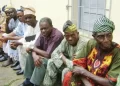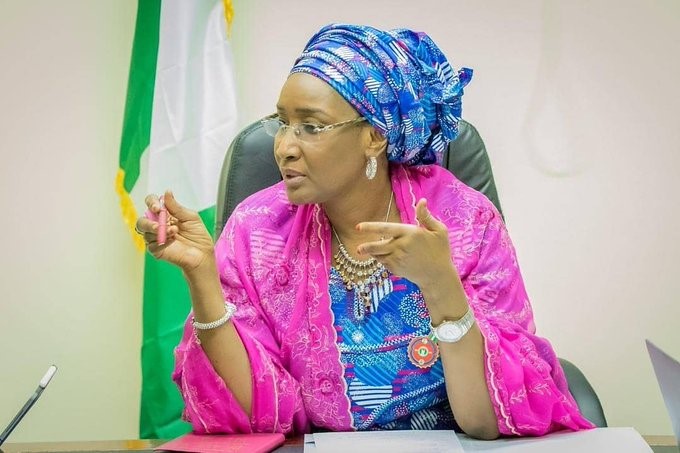
The federal government, Thursday, flagged off disbursement of cash grant for the vulnerable groups in the Federal Capital Territory, FCT.
The grant, according to the Minister of Humanitarian Affairs, Disaster Management and Social Development, Hajia Sadiya Umar-Farouq, who spoke at the ceremony in Abuja, was meant to uplift many poorest and vulnerable citizens nation wide.
The minister added that the grant was part of efforts by President Muhammadu Buhari’s administration to address some development challenges citizens were grappling with in the country.
She said, “Since the inception of President Muhammadu Buhari’s administration in 2015, the Federal Government has sustained efforts in promoting listening to the plight of the poor and vulnerable in the country.”
“This led to the introduction of the National Social Investment Programme (NSIP) as a strategy for enhancing social inclusion for all,”she explained.
The minister, while noting that, “The NSIP is one of the largest social protection programmes in Africa with over $1 billion earmarked annually to positively impact the lives of the poor and vulnerable in the country”, added that ”since its introduction in 2016, the NSIP has changed the lives of the poor and vulnerable in Nigeria.”
“I have personally seen the life-changing experiences of many poor people who lived below the poverty line and those that are vulnerable to shocks.
“Over 12 million households Nigerians (and still counting) have benefitted from NSIP interventions in the last 5 years, including nearly 1 million unemployed graduate beneficiaries under the15,952 N-Power beneficiaries under Batches A, B and C nationwide, each taking home a monthly stipend of N30,000,”she said.
Açcording to her, the NSIP has “an estimate of nearly 300,000 non-graduates receiving training and starter-packs empowerment, in addition to a monthly stipen of N10,000 for a period of 9 months. “
“Also, nearly 12 million poor and vulnerable households have been recorded in a National Social Register (NSR) from which 2 millionC1, 15,908 poor and vulnerable households have been mined into a National Beneficiary Register (NBR) who are receiving monthly cash transfer of N5,000.00, also and an estimated 9.8 million in 81,416 Primary 1-3 pupils nationwide are receiving nutritious meals prepared by over 100,000868 cooks who are all women in the FCT.
“Furthermore, nearly 3 million Nigerians have benefitted under the GEEP and about 1 million are going to access the GEEP loans soon,” she said.
The minister said “with the creation of the Federal Ministry of Humanitarian Affairs, Disaster Management and Social Development by President Buhari in 2019, I have instituted processes to ensure institutionalization and restructuring of the NSIP to respond to ensure the right beneficiaries are targeted, and to enhance impact of the programme on target beneficiaries.”
” In view of the life-changing experience of beneficiaries of NSIP, President Buhari graciously approved the expansion of the programme to touch more lives and lift more Nigerians out of poverty.
“We will also intensify effort to ensure implementation of this laudable pro-poor programmes is sustained beyond this Administration so that Nigeria will remain on the trajectory of poverty alleviation and achieve our national and global development goals by 2030,”she said.
She explained that “the Grant for Vulnerable Groups (GVG) programme was introduced in 2020 to sustain the social inclusion agenda of President Buhari’s Administration.”
“It is consistent with the national target of lifting 100 million Nigerians out of poverty in 10 years. It is designed to provide a one-off grant to some of the poorest and most vulnerable women in rural and urban areas of the country.
“A cash grant of N20,000.00 is being disbursed to poor women and youths across the 36 States of the Federation and the Federal Capital Territory.
“Our target in the FCT is to disburse the grant to over 2,900 beneficiaries across the 6 area councils.”
According to the minister, “In line with President Muhammadu Buhari’s social inclusion, 70% of the total number of beneficiaries is for women while the remaining 30% is for the youths.”
“In addition, about 15% of the total number of beneficiaries is specifically allocated to the segment of the population with special needs, including Persons with Disability (PWDs), internally displaced persons (IDPs) and senior citizens in the FCT.
” The cash grant we are disbursing today is expected to increase income and productive assets of the target beneficiaries, especially when economic challenges at global and local levels are worsening, affecting the socioeconomic conditions of our people.
“It is our hope that the beneficiaries of this programme will make good use of the grant to improve productive activities that would generate more income and improve their living standard.
“We hope to see petty traders, peasant farmers, artisanal workers and other beneficiaries of this programme including people with disabilities to prospering,”, she said.