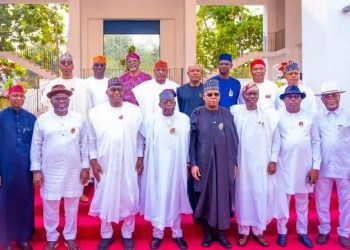
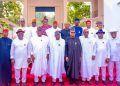
Recently, the All Progressives Congress’ (APC) governors met with the President-Elect, General Muhammadu Buhari (retired), in Abuja, lamenting their frustrations and inability to pay workers’ salaries and appealing for a bail-out of the 36 state governments after his inauguration on May 29. “…As it stands today, most states of the federation have not been able to pay salaries; and even the Federal Government has not paid April salaries…”, they were quoted as saying. But the Minister of Finance and Coordinating Minister for the Economy, Dr. Ngozi Okonjo-Iweala, in response, said governors of cash-strapped states should be blamed for the development, because they were told through the Revenue Mobilisation, Fiscal and Allocation Commission (RMFAC) to make wage payment a priority. The minister said contrary to the “misinformation being put forward by certain governors to the effect that federal workers are being owed, staff salaries at the federal level are up-to-date…workers have received their April salaries”.
Four years ago (November 2011), the Senate had raised the alarm that most state governments were going broke, a development the upper legislature attributed to growing wage bills and low revenue allocation from the Federation Account. Complicating the matter, according to the Senate, was the implementation of the N18, 000 monthly minimum wage approved by former President Olusegun Obasanjo administration. Indeed, for close to a year now, revenue allocation to states from the Federation Account has been on the decline. Now made worse by the persisting slump in oil prices and naira devaluation, Okonjo-Iweala points to a 50 per cent drop in revenues, which, according to her, simply means that salaries should be prioritised.
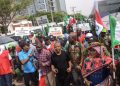
Reports as at 2014 year end indicated that workers across the country were contending with backlog of unpaid salaries as at December that year. A statement issued in Kaduna by the then Vice President of the Nigeria Labour Congress (NLC), Issa Aremu had complained about the nonpayment of workers’ salaries in 22 states in the country. That number must have increased about now, particularly as some states must have stretched their resources to the limit during the just concluded general elections. It is claimed, for instance, that some states owe workers five months’ salary arrears or more. There were, indeed, reports that workers in debtor states might proceed on strike beginning from this week; as the Comrade Ayuba Wabba-led NLC was said to have directed state councils in the affected states to hold their governors responsible for the delay in salary payment. Even being contested is Okonjo- Iweala’s claim that all federal workers have been settled.
The situation has remained grim and regrettable; and it ought to be remedied immediately, if wishes were horses. But as we have repeatedly argued, Section 2 of the 1999 Constitution (as altered) defines Nigeria as a federation consisting of states and a Federal Capital Territory (FCT). A federation implies a government in which power is shared between a government at the centre and the constituent units that make up the federation, in this case states/local governments. Under such a setting, states are expected to fend for themselves financially, independent of the government at the federal level. Such was the arrangement during the First Republic until the military intervention into politics on January 15, 1966 turned the country into a unitary state that pays mere lip service to federalism and all it entails. States have since then been depending heavily on the statutory monthly allocation from the Federation Account, a development that nurtures their penchant for being spoon-fed, instead of scouting for alternative sources of revenue and being prudent with staff recruitment.
Bloated recurrent expenditure, fraud, outright looting by some reckless governors, poor accounting system, which permits huge waste; and off-the-mark priorities are some of the inherent problems dogging most of the states presently. For any reprieve to come their way, therefore, the aforementioned setbacks would need to be frontally confronted. Borrowing from commercial banks to run government and pay salaries, as some states are being tempted to do, will worsen their predicament. It amplifies how unviable such states have become. Consequently, even under the subsisting federalist hypocrisy, the ultimate bet for any state that wants to survive is to establish independent sources of revenue, as well as taking deliberate steps to cut down on recurrent expenditure, pending when the country decides to face up to the realities of fiscal federalism and the indestructibility of the derivation principle in revenue sharing.